How to Choose the Right Hose for Industrial Applications

A failed hose rarely fails quietly. It can shut down a production line, spray hot oil across a work cell, or contaminate a batch of product in seconds. That's why learning how to choose an industrial hose matters just as much as selecting the pump or valve it connects to.
This guide walks factory owners, engineers, maintenance teams, and procurement professionals through the technical factors that separate a reliable hose from a costly liability. By the end, you'll know how to match a hose to its job, avoid common selection errors, and decide when rubber beats plastic.
Why Correct Hose Selection Matters
The right hose protects three things: your people, your product, and your uptime. An undersized or mismatched hose creates pressure drops, leaks, and premature wear. In high-energy systems, a burst can cause serious injury.
Getting it right also controls cost. Replacing hoses too often eats into maintenance budgets, while unplanned downtime multiplies the damage. Treat hose selection as an engineering decision, not a catalog guess.
Start With the Media Being Transferred
The first question in any industrial hose selection guide is simple: what's flowing through it?
The fluid or material dictates the material the hose must be built from. Common categories include:
Water and air — general-purpose rubber or PVC hoses often work well.
Fuels, oils, and lubricants — require oil-resistant compounds like nitrile.
Acids, solvents, and aggressive chemicals — demand a chemical-resistant hose with EPDM, PTFE, or UHMWPE liners.
Abrasive slurries and dry solids — need thick, wear-resistant tube walls.
Food, beverage, and pharma — call for non-toxic, taste-free, sanitary-grade liners.
Always confirm compatibility against a chemical resistance chart. A liner that swells or cracks on contact with the media will fail fast, no matter how strong it looks.
Match Working Pressure and Burst Pressure
Every hose carries two pressure ratings that you must understand:
Working pressure — the maximum pressure the hose can safely handle in continuous use.
Burst pressure — the point at which the hose fails, usually rated 3 to 4 times the working pressure.
That ratio is your safety factor. For a high-pressure industrial hose in hydraulic systems, never operate near the working pressure limit. Account for pressure spikes too. A hydraulic press or pump surge can briefly exceed steady-state pressure and destroy an underrated hose.
Example: a hydraulic line rated at 3,000 PSI working pressure should show a burst rating around 12,000 PSI. If your system spikes to 3,500 PSI, that hose is already living dangerously.
Consider the Operating Temperature Range
Temperature affects both the fluid and the surrounding environment. Every hose lists a temperature range, and both extremes matter.
High heat softens tubes and weakens reinforcement.
Extreme cold makes materials brittle and prone to cracking.
Steam and hot oil often need specialized compounds.
Remember that conveyed fluid temperature and ambient temperature can differ. A hose carrying warm oil near a furnace faces heat from two directions. Check ratings against the worst-case condition, not the average.
Check Resistance Properties
Beyond the media, real-world conditions attack hoses from the outside. Evaluate resistance to:
Chemicals — for splash zones and vapor exposure.
Oil — for machine shops and hydraulic areas.
Weather and UV — for outdoor or rooftop routing.
Abrasion — for hoses dragged across floors or handling gritty material.
A hose used for rubber hose for industrial applications in mining or construction often needs an abrasion-resistant cover to survive constant contact with rough surfaces.
Flexibility and Bend Radius
A hose that can't bend where you need it will kink, restrict flow, and crack early. Every hose has a minimum bend radius — the tightest curve it can take without damage.
Route your hose to respect that limit. Tight installations near actuators or rotating equipment need flexible hoses with small bend radii. If space is cramped, choose a hose engineered for flexibility rather than forcing a stiff one into a tight loop.
Size It Right: Inner Diameter, Length, and Flow
Sizing errors are among the most common and most expensive mistakes.
Inner diameter (ID) controls flow capacity. Too small, and you get pressure drops, heat, and strained pumps.
Length should suit the run without excess. Overly long hoses waste money and add pressure loss; too short creates dangerous tension.
Flow velocity must stay within recommended limits to avoid turbulence and wear.
Match ID to your system's flow rate rather than simply copying the port size. A quick flow-velocity calculation during design saves months of trouble later.
Reinforcement and Construction
The hose wall is engineered in layers, and the reinforcement layer determines strength.
Textile braid — flexible, good for low-to-medium pressure.
Single or multiple wire braid — for higher pressure hydraulic lines.
Spiral wire — for very high pressure and pressure-spike resistance.
Construction quality also shows in the tube and cover bonding. Poorly bonded layers separate under pressure. When comparing options, ask about the reinforcement type and how many layers the hose carries.
When to Choose Rubber Over Plastic
Material choice often comes down to a practical comparison. Understanding the differences in a rubber hose vs plastic hose decision helps you pick the right one for the environment and workload.
Choose rubber when you need:
Higher temperature tolerance and heat cycling.
Better flexibility that stays consistent in cold.
Stronger abrasion and impact resistance for rough handling.
Reliable performance in high-pressure and heavy-duty settings.
Choose plastic (like PVC or polyurethane) when you need:
Lightweight hoses for low-pressure air or water.
Clear tubing for visual flow checks.
Lower cost for light-duty or short-term tasks.
For demanding industrial work — hydraulics, hot oil, abrasive material — rubber usually wins on durability and safety.
End Fittings and Connection Compatibility
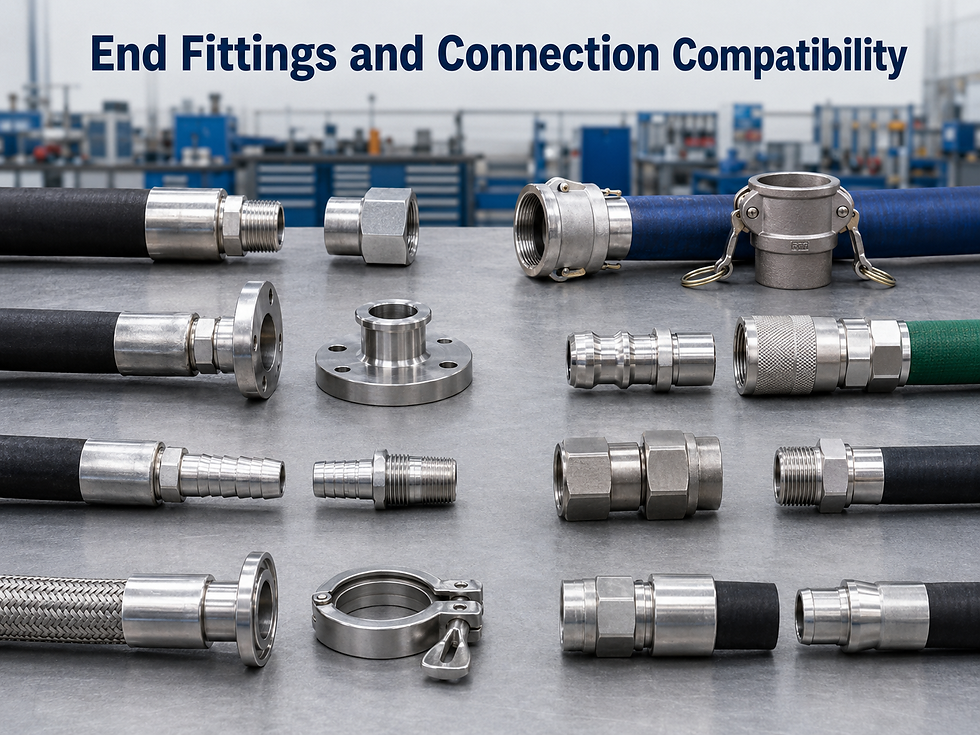
A hose is only as good as its connections. Fittings must match the hose ID, pressure rating, and thread standard of the equipment.
Confirm thread type (NPT, BSP, JIC, and others).
Match fitting material to the media and environment.
Use the correct crimping method and specification.
A mismatched or poorly crimped fitting is a leading cause of leaks and blowouts. Never mix incompatible fitting and hose brands unless the manufacturer approves it.
Safety Standards and Maintenance
Reliable hoses meet recognized standards such as SAE, EN, or ISO ratings relevant to your application. Specify these during procurement so quality is verifiable, not assumed.
Maintenance keeps hoses safe over their service life:
Inspect regularly for cracks, blisters, and abrasion.
Watch for leaks at fittings.
Replace hoses before they reach end of life, not after failure.
Store spares away from heat, sunlight, and ozone sources.
Common Mistakes to Avoid
Even experienced teams slip up. Watch for these errors:
Choosing by price alone instead of specification.
Ignoring pressure spikes and safety factors.
Copying port size instead of calculating flow.
Overlooking chemical compatibility with the liner.
Bending hoses tighter than their minimum radius.
Reusing old fittings on new hoses.
Conclusion
Selecting the right industrial hose comes down to matching the hose to the job across every variable — media, pressure, temperature, resistance, size, reinforcement, and fittings. Skip any one of these, and you invite leaks, downtime, or a safety incident.
The biggest lesson is simple: treat hose selection as a specification task, not a shopping trip. Start by listing your media, pressure, and temperature requirements before you compare products. Use the checklist above during your next procurement cycle, verify compatibility charts, and confirm the safety standards on every quote.
Do that consistently, and your hoses will last longer, perform better, and keep your operation running safely. Which factor does your team overlook most often?
Comments